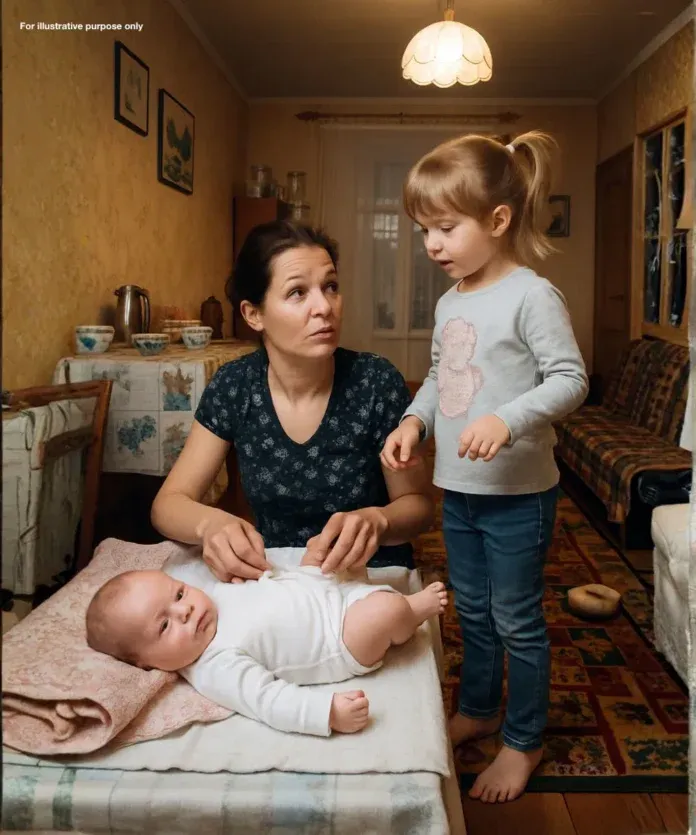
The morning my sister called, her voice was barely a whisper — thin, trembling, and wrapped in exhaustion. She had given birth only days earlier, and motherhood had already swallowed her whole. “Can you come over for a bit?” she asked. “I just need a few hours of sleep.” I didn’t hesitate. My daughter, six and endlessly gentle, was thrilled to see the new baby. We spent the morning in a haze of soft laughter and baby coos. For a while, everything felt calm — the kind of fragile peace that hovers right before something breaks.
When the baby began to cry, I did what any mother would: changed her diaper, hummed a lullaby, tried to soothe. My daughter leaned close, wanting to help — until her expression faltered. “Mom,” she whispered, pointing at the baby’s belly, “what’s that?” Faint bluish marks shadowed the newborn’s skin. My breath caught. Bruises. My first thought was to protect — to understand — to make sense of what couldn’t make sense. When I called my sister, she was silent for so long I thought the line had gone dead. Then, softly: “It was me. I didn’t mean to. She wouldn’t stop crying… I just lost control.”
Her confession broke something open inside me — not judgment, but recognition. I saw her not as a monster, but as a woman undone by exhaustion, by loneliness, by the impossible pressure to be perfect. In her voice, I heard the echo of every mother who has ever whispered I can’t do this to an empty room. That day, I realized how invisible postpartum struggle can be — how easily love and despair can live side by side when no one is watching closely enough to see the cracks. So I made a silent promise: my sister would not face this alone.
Every morning, I showed up — sometimes with breakfast, sometimes just with silence and company. I washed bottles, folded tiny clothes, held the baby while my sister slept. Slowly, her smile began to return, soft at first, then steady. Through those small acts, I learned something deeper than any dramatic rescue could teach: saving someone often means showing up before the breaking point. True compassion isn’t about grand gestures — it’s about presence. About saying, You’re not failing. You’re just tired. And I’m here. That lesson reshaped the way I love — not just my sister, but everyone who hides their pain behind brave smiles. Because in the end, family isn’t measured by perfection, but by who stands beside you when you no longer have the strength to stand on your own.