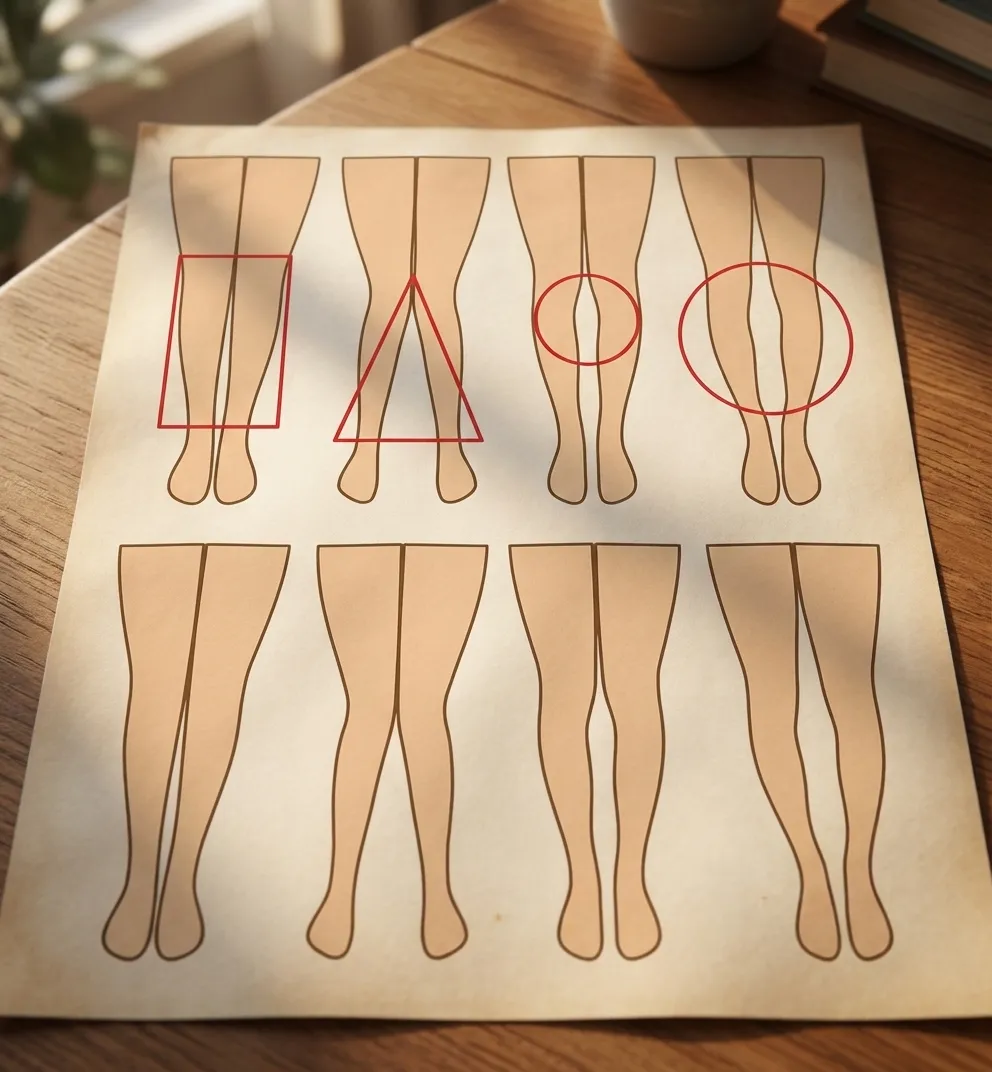
Legs are often treated as ordinary instruments of motion, carrying us from one moment to the next without much thought. Yet in conversations about appearance, style, and confidence, they’re given a surprising amount of symbolic weight, as if their shape whispers something deeper about the person they belong to. These ideas are rarely rooted in science—they’re more like cultural folklore, playful musings passed from one generation to the next. When viewed gently, without judgment, leg shape becomes less about beauty standards and more about the fascinating ways the body expresses itself through form, movement, and posture.
Most variations in leg shape come down to the quiet architecture of the body—genetics, bone alignment, and natural muscle distribution. Straight, parallel legs often get praised for symmetry, while a diamond gap or a thigh gap usually has little to do with diet or discipline and far more to do with pelvic structure. Legs that angle inward, drift outward, or meet at different points along the thighs or calves are simply following the map written in each person’s bones. These shapes aren’t flaws or virtues; they’re just patterns in the human blueprint, far more common and far less meaningful than cultural commentary suggests.
Still, people often assign personality traits or lifestyle habits to these differences in a lighthearted, imaginative way. Straight legs might be framed as grounded and confident, inward-tilting legs as gentle and relaxed, outward curves as dynamic or spirited. Though these notions have little factual basis, they reveal something else entirely—how the human mind blends anatomy with narrative, turning neutral structures into stories. Fashion and athletics pick up on these variations too, influencing what styles feel comfortable or which activities shape the muscles that sculpt the leg’s outer appearance.
In truth, a woman’s leg shape says almost nothing about her character, strength, or beauty. It reflects only the extraordinary diversity of human bodies and the unique alignment each person carries through life. Fitness can tone and strengthen, posture can evolve, but structural alignment remains largely unchanged because it was never meant to fit someone else’s ideal. What legs truly reveal is that every body moves differently—and that this diversity is not something to analyze, but something to honor. When we shift our focus from trends to individuality, we begin to see leg shape not as a verdict, but as a quiet celebration of the body we’ve been given.