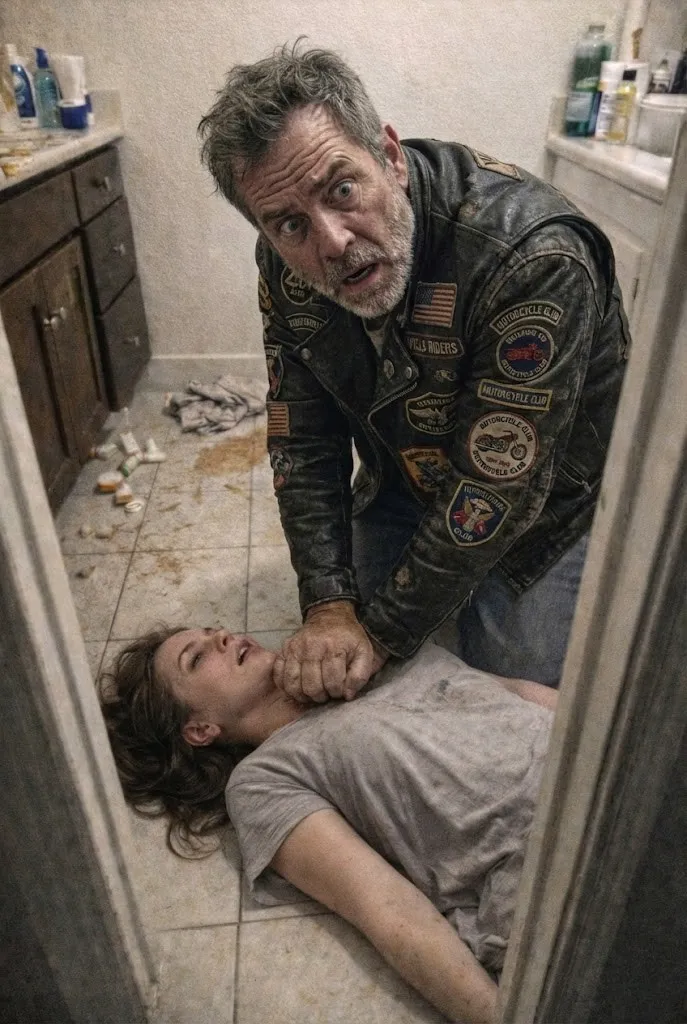
The silence of our home was shattered at 3 AM when I discovered a massive stranger in a leather vest kneeling over my nineteen-year-old daughter on our bathroom floor. Emily was a straight-A student, a library employee, and a regular at Sunday services—yet there she was, surrounded by empty pill bottles, her lips turned a terrifying shade of blue. I swung a baseball bat at the intruder’s head, only for him to catch it with one hand without breaking the rhythm of his chest compressions. He roared for me to call 911, identifying himself not as an intruder, but as Emily’s sponsor—a recovering addict named Thomas who had been the secret anchor for my daughter’s invisible war against oxycodone for over six months.
Thomas was a man built of scarred knuckles and gray beard, a figure my wife and I had been conditioned to avoid, yet he was the only person in the world who truly knew our daughter. While we saw “perfection,” Thomas saw the “demon” she had been battling since a wisdom tooth surgery spiraled into a street-level addiction. He had spent 180 consecutive nights answering her calls at 2 AM and 4 AM, providing the only judgment-free space Emily felt she could occupy. On that final night, he recognized the hollow tone of a “goodbye call” and broke every speed limit to reach our unlocked front door, performing CPR for eight agonizing minutes until the paramedics arrived to take over the life he had stubbornly refused to let go.
The revelation of Emily’s secret life left me sitting on a toilet lid in a daze, grappling with the fact that my daughter had been more afraid of our “perfection” than she was of her own death. Thomas, sitting on the edge of the tub with his head in his hands, revealed the source of his own relentless devotion: a daughter named Rebecca who had died alone in a motel room fifteen years prior because she was too ashamed to ask for help. He couldn’t save his own child, so he spent his life answering the phone for everyone else’s, acting as a human bridge between despair and a second chance. He didn’t just give Emily her breath back; he gave her permission to be “broken” and still be loved, a lesson that finally shattered the dangerous illusion of our family’s perfection.
Two years into her recovery, Emily no longer hides behind the weight of her shame, choosing instead to work at a recovery center where she turns her past “disappointment” into a source of survival for others. We still have dinner once a month with Thomas, the man who is now less a stranger and more an ancestral part of our family’s fabric. Every Thanksgiving, we toast to the scary-looking hero who answered his phone at 2 AM, proving that a true bloodline isn’t defined by names or “perfect” reputations, but by the courage to show up when the world is silent. We nearly lost her to the silence, but we found her again in the thunder of a motorcycle and the unwavering heartbeat of a man who refused to let another daughter die alone.