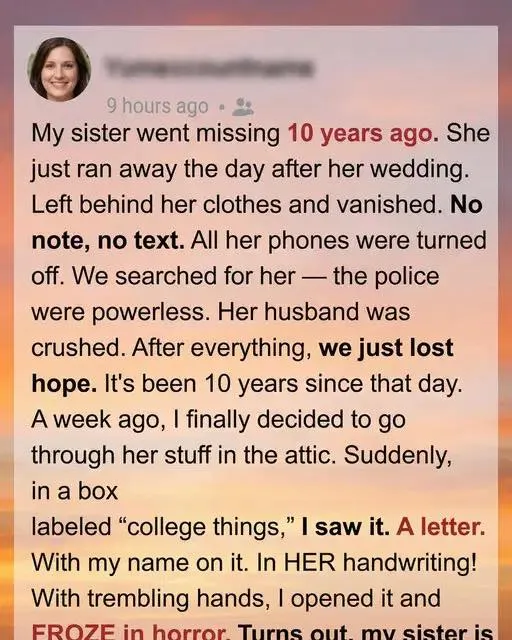
For a decade, my family lived with a question that hollowed us out from the inside: why did my sister vanish the morning after her wedding? Her clothes were still in the closet. Her phone was dead. There was no note, no trace, no explanation. We searched every road, every town, every possibility. The police found nothing. Her new husband broke under the weight of grief, and eventually, even hope learned to grow quiet. Ten years passed like a shadow stretching across our lives—heavy, unanswered, and constant. Then last week, while sorting through her old college boxes tucked away in the attic, I found a single envelope with my name written in her unmistakable handwriting. Time seemed to fold as I held it. With trembling hands, I opened it—and suddenly, after ten years of silence, she was speaking to me again.
The letter was brief, but every sentence carried the weight of the life she had run from. She wrote that she loved us—deeply—but that she had been swallowed by an overwhelming fear she couldn’t explain. Not fear of her husband, not fear of marriage itself, but fear of losing herself under the weight of expectations she’d been carrying for years. She admitted she felt like a stranger inside her own life, unable to breathe beneath the identity everyone expected her to embrace. The wedding, she said, had been the moment she realized she was following a path she hadn’t chosen freely. Instead of asking for help—something she’d never learned how to do—she ran. She didn’t reveal where she went. She only explained that distance was the only way she knew to save herself, and that she hoped, someday, I would understand.
In the days after reading her letter, I found myself replaying our childhood in my mind with new eyes. She had always been the dependable one, the strong one, the one who never cracked under pressure. Perhaps we mistook her silence for strength. Perhaps she was drowning long before she disappeared, hiding her fears behind a smile because she didn’t know how to disappoint the people she loved. The wedding we had celebrated as joyful might have felt, to her, like the final step into a life she no longer recognized as her own. My anger—the anger I had buried and nurtured for years—softened into something I never expected: compassion. She hadn’t abandoned us out of selfishness or cruelty. She left because she didn’t know how to stay without losing herself entirely.
I placed her letter in a small box beside my bed, not as a memorial of loss but as a fragile thread of connection—a reminder that she loved us enough to explain herself, even if it took ten years. When I shared her words with the rest of our family, something shifted. The grief we’d carried for so long didn’t reopen—it finally began to heal. We remembered her with warmth instead of resentment. And now, each night, I send out a quiet hope into the darkness: that someday she will return, not out of guilt or pressure, but because she has found herself again. And when that day comes, we will meet her with understanding, forgiveness, and arms that have never stopped waiting for her.