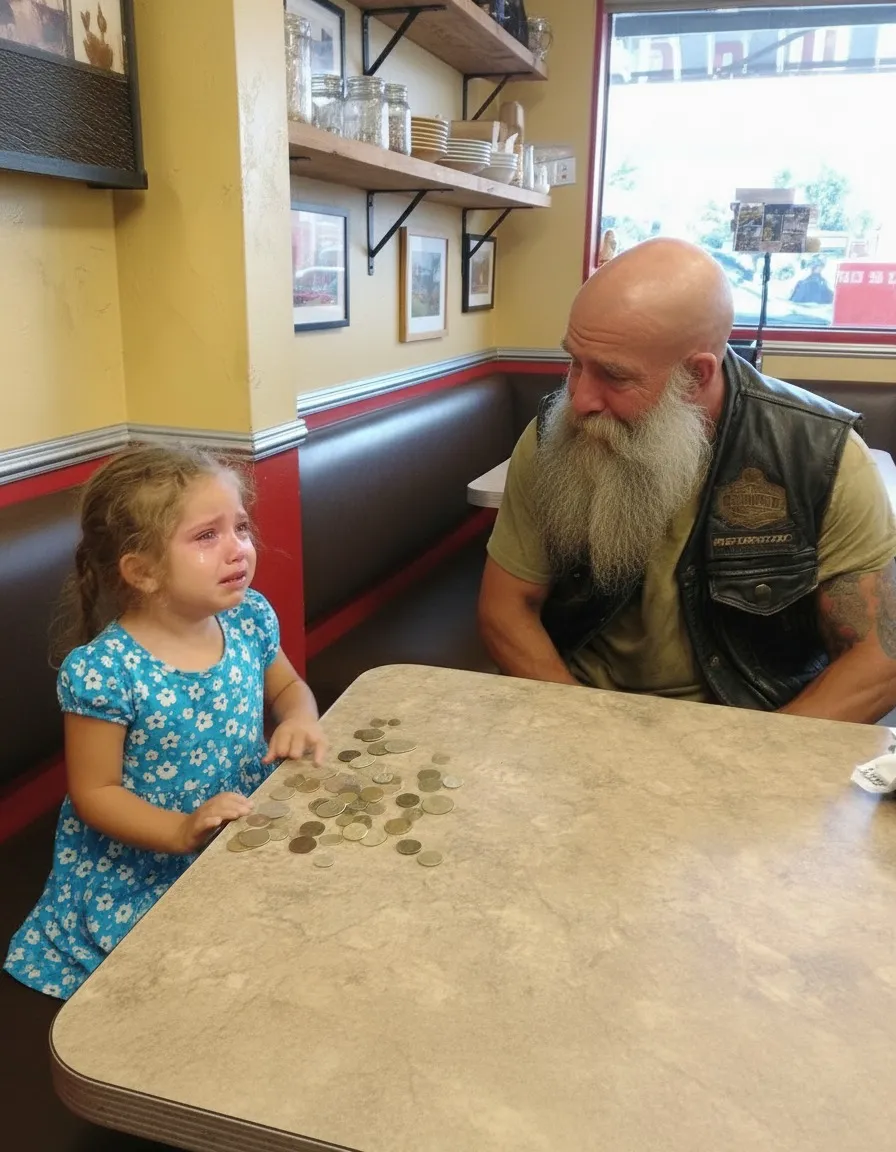
I was halfway through a mediocre cup of diner coffee when a little girl named Emma emptied her piggy bank onto my sticky table, counting out exactly $4.73 in pennies and nickels. She begged me to teach her father how to ride again, whispering through tears that he hadn’t stopped crying since the accident took his legs and his will to live. I looked through the window at the man slumped in a wheelchair by the curb—a Marine named Marcus whose eyes were fixed on my Harley with a longing so heavy it could have cracked the pavement. He was a man drowning in the silence of his own pride, entirely unaware that his daughter was currently skipping her school lunches just to buy him back a fragment of the hero he used to be before the world went dark.
What Emma didn’t know was that my shop, Morrison Custom Cycles, was built specifically for veterans like her father—warriors who believed their time in the wind had ended the moment their bodies broke. I recognized Marcus’s name immediately because I had spent the last six months staring at a bike commissioned for him by the widow of his best friend, Tommy Valdez, who hadn’t survived the same explosion that cost Marcus his mobility. I pushed her pennies back and told her to bring her father inside, not because I needed her money, but because I needed him to see the photographs of triple-amputees and paralyzed corporals who were already back on the road. I had to convince him that the “muscle memory” of a rider isn’t stored in the legs he lost, but in a soul that still vibrates at the frequency of a thousand cubic centimeters.
When Saturday finally arrived, Marcus wheeled into my shop with the wary, defensive posture of a man expecting a lecture on inspiration, only to be met by the raw, oily reality of an adaptive Harley Street Glide. We had modified it with integrated hand controls, a specialized seating system, and deployable stabilizers that allowed for the same leaning physics he’d mastered on the racing track years ago. The moment his calloused fingers touched the matte-black tank, the “dead look” I’d seen in the diner was replaced by a fierce, kinetic spark of recognition. Surrounded by a tribe of veterans who had all frozen in that same doorway once, he realized that he wasn’t a “project” to be fixed, but a rider who had simply forgotten how to mount a machine that had been waiting for him to find his own courage.
Two years later, Marcus is no longer the man slumped in the parking lot; he’s the one teaching new arrivals how to navigate the world on hand-shifted gears and custom-built frames. That $4.73 in nickels and pennies now sits framed on our shop wall, a “best investment” that served as the catalyst for a resurrection no amount of government funding could ever buy. Every time we watch a broken soldier reclaim the horizon at sixty miles per hour, I’m reminded of my own daughter who once sold her bicycle to help me rebuild mine, proving that some miracles are paid for in lunch money and pure, stubborn love. We don’t just build motorcycles here; we build the bridges that allow people to chase the sunrise they thought they’d lost, one gear shift at a time.