Sometimes, change begins not with outrage, but with quiet authority. When 68-year-old Eleanor Vance boarded a flight from Atlanta to Seattle, she looked like any other retiree — composed, gracious, unassuming in her navy-blue suit. Few passengers realized she was a former FAA safety inspector, a woman who had spent forty years ensuring the skies stayed safe. This trip wasn’t work; it was a long-awaited visit to her grandchildren. Yet before the plane would land, Eleanor would remind everyone aboard — and eventually, an entire airline — that true professionalism starts with respect.
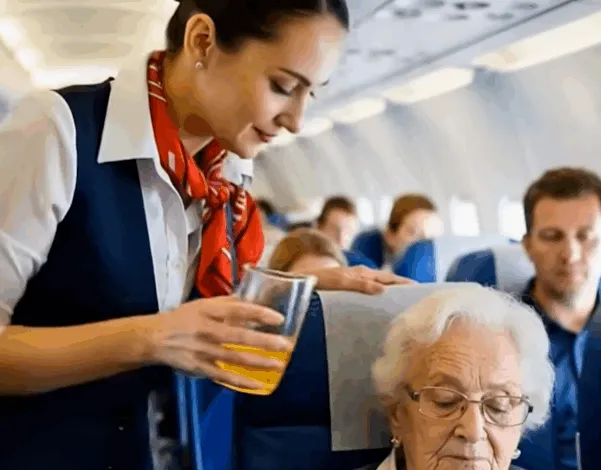
It began with something small: a glass of water. When Eleanor politely requested it, the lead flight attendant, Victoria Hale, responded with a smirk. Moments later, she returned — not with water, but with a cup of orange juice, which she deliberately tilted, spilling it across Eleanor’s lap. Gasps rippled through the cabin as the cold liquid soaked her suit and papers. Eleanor didn’t shout or curse. She simply looked up and said, “That was unnecessary.” Her voice, steady and calm, carried more weight than any anger could. The younger attendant rushed forward, apologizing and offering napkins, but the damage — to dignity and decorum — was already done. That’s when Eleanor reached into her jacket and revealed her FAA credentials. The smirk vanished. “I’d like to speak with your captain,” she said evenly, and the entire cabin fell silent.
When the captain arrived, Eleanor explained everything with precision — no embellishment, no drama. She spoke about conduct, safety culture, and respect as a foundation of professionalism. The younger attendant corroborated every word. By the time the plane landed, an official FAA incident report had already been filed. What followed wasn’t just a reprimand — it was a reckoning. Investigators uncovered systemic problems: toxic leadership, ignored complaints, and an internal culture where arrogance had replaced accountability. The fallout was swift. Victoria Hale was dismissed, several supervisors disciplined, and the airline ordered to overhaul its entire crew management program. New training protocols emphasized empathy, teamwork, and communication — the human factors Eleanor had long argued were as critical as mechanical ones.
Months later, Eleanor flew again on the same airline. This time, the service was flawless. A young flight attendant — the same woman who had apologized that day — greeted her with warmth and confidence. “Would you like some water before takeoff, ma’am?” she asked. When she placed the glass on a napkin, her smile was genuine. The flight ran smoothly, the crew worked in perfect sync, and Eleanor felt something she hadn’t felt in years: quiet pride. As the plane descended, the captain commended the crew over the intercom for their “exemplary professionalism.” The young woman caught Eleanor’s eye and nodded — not out of guilt, but gratitude.
Eleanor never sought publicity, turning down every interview. “It wasn’t about revenge,” she told a colleague later. “It was about the standard we owe each other in this job — and in life.” Her calm response became FAA training material, a case study in how one composed act of integrity can ripple outward to change an entire system. A single glass of spilled juice had become a symbol — not of humiliation, but of reform. And when asked what she thought of it all, Eleanor just smiled and said, “I only asked for water. The rest was just turbulence settling into clarity.”