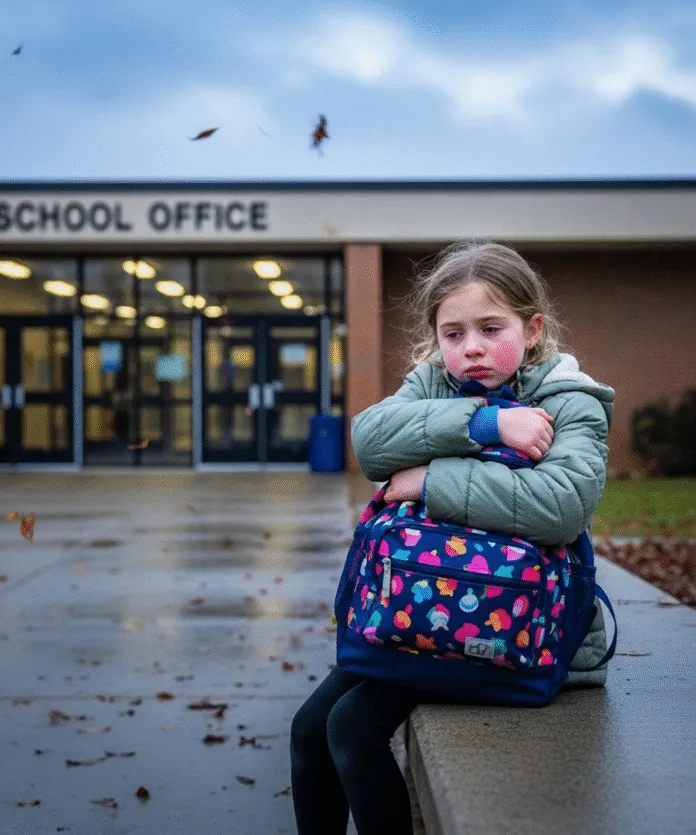
The moment I found my seven-year-old daughter shivering on a concrete school bench—her tiny body folded in on itself, fever bright on her cheeks—something in me cracked clean down the center. I had rushed across town after my own mother refused to help, her voice still ringing in my ears: “I’m not your babysitter.” Not I’m busy, not I’ll try, just a door slammed in my face. I lifted Lily into the car, wrapped her in my jacket, and drove home with a certainty I’d never felt before: I would never again beg someone to show up for my child. That night, as she slept fitfully, I realized that my mother’s words hadn’t just been cruel—they had redrawn every map I held of what family meant.
So I drew new lines. Quiet ones. Firm ones. When my mother appeared weeks later in the Target aisle, eager to reclaim a role she’d abandoned hours earlier on that cold bench, Lily barely recognized her. And when my mother invited herself along to a visit with someone who had shown up—our neighbor Carol—I said no with a calmness that surprised even me. Family, I learned, isn’t defined by titles; it’s defined by presence, and absence has its own vocabulary. The fallout was swift: angry messages, relatives pleading for reconciliation, even a revised will delivered to my mailbox like a threat disguised as paperwork. But for the first time, the chaos around me didn’t sway me. Protecting Lily felt steadier than pleasing anyone else ever had.
The months that followed were messy, tender, and human. My parents crashed Lily’s birthday party. An ice storm left them stranded with a flat tire. I didn’t bend. Boundaries are painful at first—sharp, unfamiliar—but they are the only way to teach others where the breaking points are. And yet, when Lily asked softly one night if she still had a grandmother, something inside me softened just enough for air to get through. Healing rarely begins with declarations; it begins with small, safe invitations. A short visit at the park. No gifts. No drama. My mother pushed Lily on a swing with a cast on her wrist, cautiously, like she understood the fragile beam of trust she was balancing on.
Now, we live in a world held together by quiet rules and cautious hope. My mother shows up—not perfectly, not dramatically, but consistently enough that Lily can draw her into family pictures without confusion. And I’ve learned that forgiveness isn’t surrender—it’s architecture. It’s deciding where the doors go, and how wide they open. The day my mother refused to help was the day I finally learned how to protect the life I’m building for my daughter. Some bridges burn, some collapse, and some survive because a child asks, gently, if they can. And for Lily—for her small hands reaching across a playground toward a grandmother she still wants—I chose to rebuild just enough to let the sunlight through.