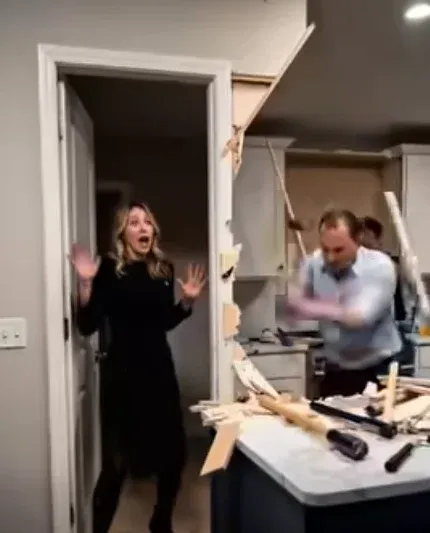
I came home early from work thinking I’d surprised myself with an extra quiet hour, maybe a cup of coffee in the one room I’d poured my soul into. Instead I walked into the sound of destruction. A sledgehammer cracking stone. Power tools whining like angry insects. Men’s boots dragging through my house like it belonged to them. My stepfather Ray stood in the middle of my kitchen swinging that hammer with the confidence of someone who believed he could rewrite my life with brute force, while my sister Kimmy hovered nearby directing her husband’s crew as they ripped out the custom cabinets I’d saved for and designed myself. My kitchen wasn’t just pretty it was my portfolio, my proof, the one space that felt like mine after years of keeping distance from a family that treated my boundaries like personal insults. And in seconds, they turned it into rubble like my pride was something they could tear down for fun.
When I demanded they stop, Ray didn’t hesitate. He crossed the room and hit me in my own living room like he’d been waiting for the moment to remind me who he thought I was. I tasted blood and disbelief at the same time, and the worst part was how quickly the drilling started up again, as if my pain was background noise. Kimmy’s voice went sweet, the way it always did when she was doing something cruel and wanted it to sound reasonable. She said I was being dramatic, that they were improving the space, that I should be grateful, that this would all be funny later. Ray said family helps family, like destruction was a gift and obedience was the price. I realized, sitting there stunned against my own wall, that they didn’t see my home as my home. They saw it as a prize. A resource. A stage they could take over because I had built something they hadn’t, and they were angry at the proof.
I didn’t scream. I didn’t fight them. I left. Not because I was afraid of them in that moment, but because I understood something with cold clarity. If I stayed, I’d be reacting to their chaos instead of controlling the outcome. So I went somewhere safe, documented my injuries, and made the kind of calls that don’t feel dramatic until you’ve needed them. A lawyer. A locksmith. My insurance company. Then I gathered evidence like it was oxygen: medical documentation, timestamps, witness statements, footage from neighbors that caught faces and license plates and the moment appliances were carried out like stolen trophies. By the time the police arrived, it wasn’t my word against theirs. It was a timeline. It was proof. It was the difference between a story people dismiss and a case that can’t be ignored.
In the end, they didn’t lose everything because I wanted revenge. They lost everything because they chose violence and greed and assumed I’d swallow it the way I had as a kid. Charges were filed. Orders were signed. The crew scattered. My stepfather’s “authority” crumbled the moment it had to face daylight. My sister’s performance couldn’t survive facts. Standing in my wrecked kitchen afterward, I felt grief for what they destroyed, but something else too, something steadier than anger. Relief. Because the real thing they’d tried to take wasn’t quartz or cabinets or a beautiful stove. It was my sense of safety, my right to say no, my right to own what I built. I rebuilt the kitchen, yes, but more importantly I rebuilt my boundaries into something they could never swing a hammer through again.